
Home » 2025
Yearly Archives: 2025
PMP exam eligibility requirements
As PMP exam renewal is announced since July, 2026, the updated requirements for exam eligibility are published at the PMP(r) official page –
Set A requirements
- High school or secondary school diploma
- Minimum 60 months/5 years experience leading and managing projects within the past eight years
- 35 hours of project management education/training. You can also meet this requirement with:
– CAPM® certification or
– Instructor-Led PMP® course (Available Online and In-Person)
Set B requirements
- Bachelor’s degree or higher (or global equivalent)
- 36 months/3 years experience leading and managing projects within the past eight years
- 35 hours of project management education/training. You can also meet this requirement with:
– CAPM® certification or
– Instructor-Led PMP® course (Available Online and In-Person)
Set C requirements
- Bachelor’s degree or higher (or global equivalent) from a GAC accredited program
- 24 months/2 years experience leading and managing projects within the past eight years
- 35 hours of project management education/training (GAC core project management course work is pre-approved to fulfill this requirement)
Our mentee startup success and growth
I am inspired to introduce Petinder (which is developing to a huge AdoptPetHub.com brand).

Starting in 2022 as a Social business startup Petinder involved both business and social parts, building strong core team, amended with a wide number of volunteers.
Social part of the service offers search engine for pets adoptio0n and care, including leisure options, co-workings, sport events, hotels, beaches, and many other services.
The business part includes “tools and information on dog walkers, pet sitters, dog trainers, and groomers, helping pet owners find trusted professionals to care for their furry friends”.
The inspiring essence of this project is hybrid – employees and volunteers team.
AdoptPetHub.com
The service is rapidly developing leading by its Founders, and now it’s transforming to a larger Adopt Pet Hub mega service!
PMI updates its flagship products
Project management institute (PMI) issued PMBO 8th edition (Our overview and analysis coming soon)
PMP certification exam will be updated since July, 2026. Content outline is published.
Main updates and topics are
- Future-forward topics, like AI, sustainability and valueWe’ve incorporated emerging topics to keep exam content current.
- Adaptive approaches that reflect how teams work todayAgile and hybrid methods will be emphasized over predictive approaches.
- Defining project success through outcomes and impactValue delivery will be emphasized over scope, schedule or cost.
- Inclusive, globally aligned eligibilityApprenticeships and vocational education will be recognized.
Ethix Code is updated as well.
And PMI’s AI assistant Infinity is updated –
The next iteration of AI that speaks project management, now available on PMI.org and the PMI Official mobile app.
Meeting PMBOK 8th
PMBOK8 synthesizes value system thinking, leadership, culture, and technology. The next version of RMVOC is an attempt to synthesize the 6th edition (structure), the 7th (philosophy) with the addition of manufacturability (AI).
PMBOK8 has its own focus on different areas:
1 Sustainability Integration – for the first time as a separate principle and a constant topic in domains.
2 Digitalization and AI – represented by a standalone application with use cases (risk prediction, data analysis, assistants). In my opinion, somewhat speculative, we’ll see.
3 The principle of evidence-based tailoring emphasizes the need not to blindly follow a standard, but to adapt to realities, which has long been talked about by practitioners.
4 The return of the process approach – Process Groups – with an emphasis on flexibility.
5 The emphasis on value, culture and leadership remains.
Comparison table (Note: Based on the best practices of Re:Work Consulting (Kazakhstan).
| Aspect | PMBOK® 7 | PMBOK® 8 | Distinction / Development |
| Number of Principles | 12 | 6 | Consolidation: consolidation of overlapping principles, simplification to guiding principles |
| Domains | 8 ( Stakeholders, Team, Development Approach, Delivery, Planning, Project Work, Uncertainty) | 7 (Governance, Scope, Schedule, Finance, Stakeholders, Resources, Risk) | Return to the classic areas of management, but without rigid processivity |
| Process groups | Were excluded | Returned as Focus Areas | Balance between predictive and adaptive approaches |
| Content | Conceptual and fundamental | Combined (principles + processes) | Reintegration of practical elements based on 40 updated processes |
| Sustainability | Mentioned indirectly | A separate principle has been introduced | first enshrined in the PMI standard |
| AI and digitalization | Mention in the context of Tailoring | New section of Appendix X3: Artificial Intelligence | Reflecting the trend for AI support for project management |
| PMO | A separate section was missing | Appendix X2: Project Management Offices | Expanded focus on the role and evolution of PMOs |
| Tailoring | Conceptually | Detailed Step-by-Step Process (3.4) | Added diagnostics and continuous improvement cycle |
| Value Delivery | Central concept, connection with the product | More formalized | A system chapter “A System for Value Delivery” has been added |
AI module in IT Service management online course
Our course IT Service management has a new module now – AI in ITSM.
Learn which roles can AI play in ITSM – boring and generative. We discuss risks, achievements, challenges and advantages of applying AI for IT service management.
Join or Retake our course NOW!

PMI PMBOK8 launch postponed to January, 2026
The official release date has been moved to January 2026. As a reminder, Q4 2025 was previously announced. Well, a delayed release is nothing new for PMI. 🙂
What’s new in the 8th edition?
The 8th edition of the PMBOK® Guide, like the 7th edition, relies on a principles-based approach. However, there is also a return to the classic process model, and an expanded description of process groups and processes is provided (PMI Process Group Practice Guide).
The new edition offers modern tools and approaches, reflecting the widespread adoption of AI and agile methods (which is no longer new and is reflected in the 6th and 7th editions) in project management.
The main components of the 8th edition of the PMBOK® Guide:
- The Standard for Project Management – a standard describing the key principles and processes of project management.
- The Guide to the PMBOK® — a practical guide with tools and application examples for various situations.
Key updates include:
Expanded project lifecycle terminology and structure.
Integration of artificial intelligence capabilities.
Expanded recommendations for project management offices (PMOs).
Modern approaches to procurement management.
AI applying for Service Desk
Our online course – Service operations and Service Desk – got a new module – AI in Service Desk.
Join our course here.

CPMAI – A Methodology for AI projects development by PMI
PMI has released its AI project management methodology — Cognitive Project Management for AI
The first question is why?
Traditional project management and application development methodologies do not fully address the
complexity of AI projects. AI solutions are data-driven, not just software-driven, which requires a
systematic approach that ensures:
● Alignment with business objectives and ROI
● Proper data preparation and management
● Robust model evaluation and operationalization
● Iterative development to adapt to changing data and needs
CPMAI is data-centric and based on an iterative approach.
The methodology provides 7 patterns —
Conversational and human interaction
Recognition
Patterns and anomalies
Predictive analytics and decision support
Hyperpersonalization
Autonomous systems
Goal-driven systems
The methodology includes 6 main phases

Business understanding
Data understanding
Data preparation
Model development
Model assessment
Transfer to operational use
In the presented methodology, a separate section is devoted to the issues of trust in AI, and embedding trust in each phase of the project. (Note: For those interested in issues of trust and ethics in the development of AI systems, I refer to my presentations — 1 and 2)
Key roles in AI projects
Project Manager/AI Project Lead: oversees the entire AI initiative, ensuring its compliance with the CPMAI stages. Project Manager: Provides leadership support to the AI project, allocates resources, and helps align the AI initiative with the broader organizational strategy. This role coordinates timelines, manages risks, engages with stakeholders, and ensures the project aligns with business goals.
● Data Engineer: Creates the data pipelines and architecture that power the AI systems. They
perform tasks such as data ingestion, integration, cleansing, transformation, and ensure the reliability, scalability, and security of data flows, which is critical to smooth model development and deployment.
● Business Analyst/Subject Matter Expert: Ensures the AI solution aligns with real business goals and domain needs. They help define success criteria, interpret results, and translate AI insights into actionable actions for stakeholders and end users.
● MLOps/DevOps Engineer: Bridges the gap between model development and deployment to production by managing version control, continuous integration/continuous delivery, and ongoing performance monitoring.
● Data Scientist: If an ML model needs to be developed from scratch or requires fine-tuning to extend existing models, organizations may also need a data scientist on the team. This role focuses on building and validating models. The data scientist has expertise in statistics, machine learning algorithms, and model experimentation. They must translate business needs into technical requirements and make modeling decisions accordingly.
AI Soft Skills and Culture
● Critical Thinking and Problem Solving: AI projects are experimental by nature, so
teams must be able to conceptualize approaches, test solutions quickly, and iterate.
● Communication and Storytelling: Stakeholders need clear explanations of complex AI results, whether to justify resource allocation or solve user problems.
● Collaboration and cross-functionality: AI projects span data, engineering, and business domains. Strong teamwork and cross-functional alignment are essential.
● Adaptability and tolerance for uncertainty: As models evolve and data changes, teams must be prepared for iterative cycles and the ability to iterate.
SUMMARY
Use CPMAI’s iterative, data-driven, AI-specific approach
● CPMAI’s six stages: From understanding the business (stage I) to operationalizing the model (stage VI), each stage ensures that the right problems are being addressed, the right data is in place, the AI is being developed responsibly, and that real needs are being met.
● Iterative, data-driven approach: AI projects are not static. They require iterative cycles of data preparation, model refinement, and stakeholder feedback to stay relevant and avoid drift.
● Integration with organizational processes: CPMAI stages effectively complement conventional project management practices (including Agile and DevOps/MLOps),
providing the AI-specific conditions necessary for success.
● Trustworthy AI: Ethical, responsible, and transparent development practices are integral to long-term AI adoption. CPMAI places special emphasis on bias detection, governance, and stakeholder engagement at each stage.
● Team and culture: AI success depends on the right distribution of roles – data engineers, data scientists, analysts, subject matter experts, and project managers – working together using an agile, learn-as-you-go approach.
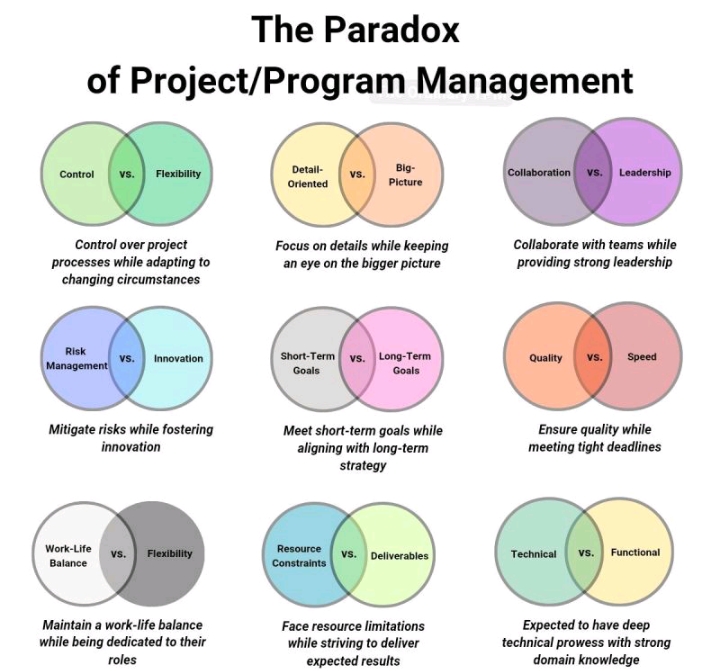
Project vs Program management
PM vs PgM in a single picture. (c) Gabor, 2025.
 Smart Learning